 Screenshot of shape pool statistics tool
Showing posts with label Segmentation. Show all posts
Showing posts with label Segmentation. Show all posts
Monday, January 05, 2009
Shape pool statistics tool
To help me while analysing the behaviour of the shape pool produced by the CAS/HFP decomposition algorithm, I developed a small tool. This tool, whose screenshot is depicted below, compares two shape pools and provides important information about them.
 Screenshot of shape pool statistics tool
Wednesday, September 03, 2008
Disjoint component identification
Within my PhD work I developed a small prototype that identifies disjoint components on 3D meshes. The "Disjoint Component Detector" takes as input an OFF file and can produce three distinct outputs. It can create a VRML file with the model colorized according to the detected disjoint components. It can create a set of OFF files, containing each one of them a single component. Or it can write a text file describing the disjoint components detection results. If interested in try it, you can download the current stable version of the prototype [ZIP 143KB].
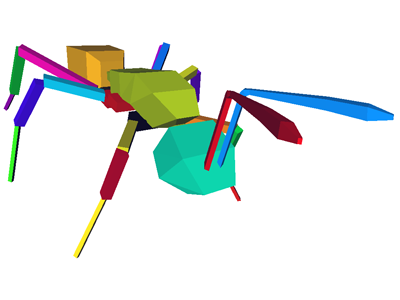 Ant model from PSB with disjoint components identified.
This simple prototype provides a straightfoward method to identify segments in some models from the PSB collection, since they are already coded with disjoint segments.
 Identifying segments using disjoint components in a model from PSB.
 Ant model from PSB with disjoint components identified.
This simple prototype provides a straightfoward method to identify segments in some models from the PSB collection, since they are already coded with disjoint segments.
 Identifying segments using disjoint components in a model from PSB.
Wednesday, May 21, 2008
CAS name change
From discussions with colleagues from SMG at IMATI-Ge, we concluded that the name originally given to the decomposition algorithm was not the most appropriate. Indeed, it might lead to some confusion and misinterpretation. Therefore, we decided to change the algorithm name to "Collection-Aware Segmentation".
Friday, May 16, 2008
In practice it is not so bad
After making some changes in the CAS algorithm and improving the prototype (basically, I write its core from scratch) I could study its behavior with larger collections. The results were positive because the growth of the shape pool is far below the simulated worst case. Indeed, after the third iteration the number of segments to add to shape pool decreases and within seventh iteration is very low. The chart bellow illustrates exactly this.

Tuesday, May 13, 2008
CAS shape pool segment growth
As I was expecting, the context-aware segmentation (CAS) approach can potentially led to an exponential growth of the number of segments in the shape pool. Theoretically, if all the branches of the segmentation tree are expanded, after seven iterations the number of segments can grow so much that will be impossible to store in memory all their signatures. The charts below illustrate the worst case for two distinct collections with one and eight hundred models respectively.
 Number of segments in shape pool
 Memory necessary to store segment signatures
 Number of segments in shape pool
 Memory necessary to store segment signatures
Wednesday, April 30, 2008
Writing CAS/HFP on XML file
Since I will now test the CAS/HFP algorithm with larger collections, I needed to devise a way to store the segmentation in order to be able to re-use it without having to process it again. Thus, I have implemented a feature that allows writing to (and reading from) a XML file the segmented collection. Moreover, the computed signatures for segments and corresponding similarities are also saved. Below is an excerpt of a XML file describing a collection decomposition.
 Excerpt of XML decomposition file.
 Excerpt of XML decomposition file.
Thursday, April 24, 2008
CAS/HFP versus HFP
During the last weeks I've been implementing the context-aware decomposition based on hierarchical fitting primitives (CAS/HFP) algorithm. Now that I finally have a working prototype, I was able to compare the result produced by CAS/HFP with the ones produced by applying only the hierarchical fiting primitives (HFP) segmentation. To that end I use a very small collection extracted from the PRECISE Engineering Shape Benchmark. Below I show the segmentation trees produced by the two algorithms for the same shape.
 Decomposition tree produced by HFP
 Decomposition tree produced by CAS/HFP
 Decomposition tree produced by HFP
 Decomposition tree produced by CAS/HFP
Monday, April 07, 2008
First approach to context-aware segmentation
In a first approach to context-aware segmentation (CAS), I have implemented a prototype that uses spherical harmonics descriptor and cord-and-angle histogram to estimate similarities between segments. This prototype decomposes all models in a given collection according to all others. Bellow is an example of a model extracted from the PRECISE Engineering Shape Benchmark and decomposed along with others from this benchmark using the CAS approach.
 View of 3D model decomposed using CAS
 View of 3D model decomposed using CAS
Thursday, March 13, 2008
Shape Segmentation with HFP
I have just combined the fitting primitives mesh clustering (HFP) algorithm proposed by Marco Attene in is paper "Hierarchical mesh segmentation based on fitting primitives" with the prototype that produces the spherical harmonics descriptor (SHA) and cord and angle histogram (CAH) for a 3D model. The result is an application that decomposes a model using the HFP approach and then computes for each segment the corresponding descriptors. This application produces a navigable VRML file containing the segmented model. By clicking on segments it is possible to see the descriptors for that segment and even the segment alone or a possible random sampling. To view an example based on a model extracted from the ESB click on screen-shot below.
 Screen-shot of shape description page.
Monday, March 03, 2008
Decomposing 3D models
Moving forward into my main goal, I am now concerned with model segmentation. In my first approach to this problem I used the fitting primitives mesh clustering algorithm proposed by Marco Attene in is paper "Hierarchical mesh segmentation based on fitting primitives". A result obtained from a model extracted from the ESB with a preliminary prototype is depicted below, different colors representing distinct segments.
 Segmented model
 Segmented model
Subscribe to:
Posts (Atom)