
Thursday, September 18, 2008
Ammersee
In the day after the Sketch Tools for Diagramming workshop in Herrsching (Germany) and before return home, I went for a boat trip in the Ammersee lake plus a walk around the town. In the picture below you can see me in the boat deck after leaving Riederau, on the oposite side of the lake.


Wednesday, September 17, 2008
EditION presented in Sketch Workshop
Last Monday I presented the paper titled "EditION: A Collaborative Calligraphic Tool to Manage Virtual Environments" at the 2008 IEEE Symposium on Visual Languages and Human-Centric Computing workshop Sketch Tools for Diagramming held on Herrsching am Ammersee, Germany. An electronic version of the paper can be downloaded from the on line proceedings.
Wednesday, September 03, 2008
Disjoint component identification
Within my PhD work I developed a small prototype that identifies disjoint components on 3D meshes. The "Disjoint Component Detector" takes as input an OFF file and can produce three distinct outputs. It can create a VRML file with the model colorized according to the detected disjoint components. It can create a set of OFF files, containing each one of them a single component. Or it can write a text file describing the disjoint components detection results. If interested in try it, you can download the current stable version of the prototype [ZIP 143KB].
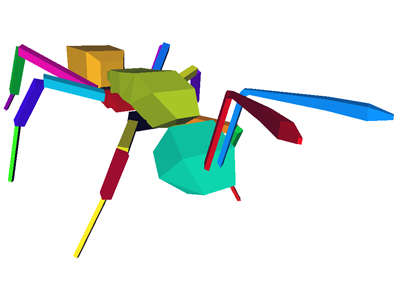 Ant model from PSB with disjoint components identified.
This simple prototype provides a straightfoward method to identify segments in some models from the PSB collection, since they are already coded with disjoint segments.
 Identifying segments using disjoint components in a model from PSB.
 Ant model from PSB with disjoint components identified.
This simple prototype provides a straightfoward method to identify segments in some models from the PSB collection, since they are already coded with disjoint segments.
 Identifying segments using disjoint components in a model from PSB.
Wednesday, July 30, 2008
Keeping words together
I needed to keep two words together in the same line while writing a document with Microsoft Word. Although this is easy to do in LATeX, I have no idea how to do it in Word. After a few searches, I found out that it is even simpler. If one wants to keep to words separated by a space together, just have to use a non-breaking space instead of a "traditional" space.
To insert a non-breaking space in Microsoft Word simply press <CTRL>+<SHIFT>+<SPACE> instead of <SPACE>.
To insert a non-breaking space in Microsoft Word simply press <CTRL>+<SHIFT>+<SPACE> instead of <SPACE>.
Monday, July 28, 2008
Professor Randy Pausch died on July 25th
Last friday, July 25th, Professor Randy Paush died of complications from pancreatic cancer. I have no words to describe the loss it represents not only for the computer science community, but for all the academic world. You can read more at the CMU page.
Monday, July 21, 2008
Paper accepted at SketchWS
The paper titled "EditION: A Collaborative Calligraphic Tool to Manage Virtual Environments" has been accepted for presentation at the 2008 IEEE Symposium on Visual Languages and Human-Centric Computing workshop Sketch tools for diagramming. According to reviewers comments, it needs just a few changes. Let's work on that!
Wednesday, July 16, 2008
Results for CaS collection decomposition
In order to allow a quick analysis of the XML file produced by the Collection-aware Segmentation (CaS) algorithm, I wrote a simple XSL transformation that shows CaS results in an easily readable format.
For instance, here you can take a look at the result of decomposing the Flat-Thin Components cluster from Purdue's ESB with CaS.
For instance, here you can take a look at the result of decomposing the Flat-Thin Components cluster from Purdue's ESB with CaS.
Friday, July 11, 2008
Hybrid Shape Descriptor by P.Papadakis
In the Eurographics 2008 Workshop on 3D Object Retrieval, Papadakis Panagiotis et.al. presented a paper titled 3D Object Retrieval using an Efficient and Compact Hybrid Shape Descriptor". Since I was very interested in this work but was not able to find it online, I send an email to Papadikis Panagiotis asking him for a copy. His quick answer (in less than twenty minutes I have the printed paper in my hands) was extraordinary and motivating. If the proposed technique is as faster as its author, it will be a blast!
Thursday, July 03, 2008
A blog on Mobile Accessibility
Tiago Guerreiro, my colleague at VIMMI group, released a blog on mobile accessibility, the topic of his PhD work. In this blog you can find news on mobile accessibility and usability. Accessibility to mobile devices and through mobile devices.
Take a look at Mobile Accessibility blog by Tiago Guerreiro.
Take a look at Mobile Accessibility blog by Tiago Guerreiro.
Monday, June 23, 2008
Tapada Nacional de Mafra
This weekend we went to the Tapada Nacional de Mafra and spent a quite pleasant time there. My son just loved to chase deers...
 Chasing a deer...
 The deer stops and looks back. Probably it is time to return.
 Chasing a deer...
 The deer stops and looks back. Probably it is time to return.
Friday, June 20, 2008
Kindergarten party
Last Tuesday I went to my son's kindergarten end-of-year party. It was a very special afternoon. Both for him and for us.
 Tiago playing his role in the "recycle theater"
 Tiago playing his role in the "recycle theater"
Thursday, June 19, 2008
Annecy 2008
After the SBIM'08 workshop and during the last day of the Annecy Animation Film Festival, Saturday, I used some spare time to enjoy the city and its surroundings. In my rollerblades I went to Duingt, a small town in the left margin of the lake, a dozen kilometers south of Annecy. It was a quite pleasant trip in a cycleway by the lake. During that day I rollerbladed more than forty kilometers, the longest distance I have ever ride in a single day. But the conditions for that were great. If you're planning to visit Annecy I strongly recommend to consider taking your bike or skates with you. It's worthy.
 Rollerblading in Annecy (France) surroundings
 Rollerblading in Annecy (France) surroundings
Wednesday, June 18, 2008
LSketchIt
Last week I've been in the fifth Eurographics workshop on sketch-based interfaces and modeling (SBIM'08). The workshop took place during the famous Annecy Animation Film Festival and was held together with the premier conference for techniques in expressive rendering and animation: the non photo realistic animation and rendering conference (NPAR'2008).
At the SBIM'08, I presented our more recent work on sketch based modeling (see paper "Using Sketches and Retrieval to Create LEGO Models"). The LSketchIt is a calligraphic tool for creating LEGO models that uses sketches and retrieval to ease and speed up the modeling process. Check out LSketchIt working in the demonstration video below.
LSketchIt demonstration video
At the SBIM'08, I presented our more recent work on sketch based modeling (see paper "Using Sketches and Retrieval to Create LEGO Models"). The LSketchIt is a calligraphic tool for creating LEGO models that uses sketches and retrieval to ease and speed up the modeling process. Check out LSketchIt working in the demonstration video below.
LSketchIt demonstration video
Tuesday, June 03, 2008
Deleting VirusScan Enterprise quarantine files
I am using the Networks Associate VirusScan Enterprise 8.0 with patch 10 and found out that it was using more than 400MB to store the quarantined files. Version 8.5 provides a tool that allows users to manage these files, the Quarantine Manager. However, version 8.0 don't have such tool and I was not even able to manually delete the corresponding ".Vir" files, since they were locked by the application.
Fortunately, I found a solution to overcome this problem in the McAfee Support Forums. Indeed it is quite simple.To delete files in the Quarantine directory, on must disable the On-Access Scanner, and delete the file. After that it is important to remember to enable it again. Although it can be done using GUI, I present bellow the corresponding console commands:
% cd \quarantine
% net stop mcshield
% del *.Vir
% net start mcshield
Fortunately, I found a solution to overcome this problem in the McAfee Support Forums. Indeed it is quite simple.To delete files in the Quarantine directory, on must disable the On-Access Scanner, and delete the file. After that it is important to remember to enable it again. Although it can be done using GUI, I present bellow the corresponding console commands:
% cd \quarantine
% net stop mcshield
% del *.Vir
% net start mcshield
Friday, May 30, 2008
Model complexity in ESB
I need to study the complexity of models in the PRECISE engineering shape benchmark (ESB) collection. Although such approximation is not always true, I considered that more complex objects contain more faces, while meshes with less triangles represent simpler models. Indeed, a simpler object might contain more faces than a more complex one, depending on the mesh. However, this is not common in the ESB collection and the face count is easy to estimate. From this estimation, I concluded that the majority of the models in this collection contain more than ten thousand polygons, as illustrated in chart below.
 Distribution of models from ESB collection according to face count
 Distribution of models from ESB collection according to face count
Thursday, May 29, 2008
Counting faces in STL files
To help me creating statistics on collections of 3D models I developed a small application that counts the faces of models stored in STL files. It can be used to analyze a single model or a collection of models. The first is done by specifying the corresponding STL file and the second by specifying the folder that contains the collection. If you think such application might be useful, you can download the windows binary [ZIP 71KB] or ask me the cross-platform source code.
 Output produced by FaceCounter application
 Output produced by FaceCounter application
Wednesday, May 21, 2008
CAS name change
From discussions with colleagues from SMG at IMATI-Ge, we concluded that the name originally given to the decomposition algorithm was not the most appropriate. Indeed, it might lead to some confusion and misinterpretation. Therefore, we decided to change the algorithm name to "Collection-Aware Segmentation".
Tuesday, May 20, 2008
Goodbye Genoa
My fellowship at CNR IMATI-Ge finished last Friday. Thus, on Saturday morning I was packing and in the afternoon embarking on a ferry to Barcelona, from where I rode to Lisbon.
I want to thank everybody at the Shape Modeling Group for the way they welcomed and supported me: it was a pleasure to work with you, guys.
 Waiting, with other motorcyclists, to went on board.
 Godbye Genova.
I want to thank everybody at the Shape Modeling Group for the way they welcomed and supported me: it was a pleasure to work with you, guys.
 Waiting, with other motorcyclists, to went on board.
 Godbye Genova.
Friday, May 16, 2008
In practice it is not so bad
After making some changes in the CAS algorithm and improving the prototype (basically, I write its core from scratch) I could study its behavior with larger collections. The results were positive because the growth of the shape pool is far below the simulated worst case. Indeed, after the third iteration the number of segments to add to shape pool decreases and within seventh iteration is very low. The chart bellow illustrates exactly this.

Tuesday, May 13, 2008
CAS shape pool segment growth
As I was expecting, the context-aware segmentation (CAS) approach can potentially led to an exponential growth of the number of segments in the shape pool. Theoretically, if all the branches of the segmentation tree are expanded, after seven iterations the number of segments can grow so much that will be impossible to store in memory all their signatures. The charts below illustrate the worst case for two distinct collections with one and eight hundred models respectively.
 Number of segments in shape pool
 Memory necessary to store segment signatures
 Number of segments in shape pool
 Memory necessary to store segment signatures
Subscribe to:
Posts (Atom)