I don't know why I took so much time to create a web page about my PhD research. However, it's better late than never, so I have just created one. It's not complete, but it is a beginning.
Visit the web page of my PhD research, which focused on Thesaurus-based 3D Shape Retrieval, T-b3DR for short. There you can find some information about my work and a couple of useful prototypes.
Wednesday, December 10, 2008

Thursday, December 04, 2008
LaTeX equation editor
I've been using a very useful tool for writing equations in LaTeX. Although it is quite easy to found on the internet, I notice that some of my colleagues did not know about it. Thus, I thought it might be a good idea to publicise it here.
So, if you're using LaTeX you should give a look at the LaTeX equation editor. It is simple, fast, and accurate. And you do not need to install anything, it runs on your web browser.
So, if you're using LaTeX you should give a look at the LaTeX equation editor. It is simple, fast, and accurate. And you do not need to install anything, it runs on your web browser.
Wednesday, December 03, 2008
Writing a number set in LaTeX
I needed to write the formal notation of a multi-dimensional dataset in my PhD dissertation. Since I'm using LaTeX and this dataset consists on a real number set I just have to use the mathbb font, provided by amsfonts or amssymb packages.
Thus, providing that the proper packages were included in the preamble of the document, I just had to use, in math mode:
\mathbb{R}^n
to obtain:

Thus, providing that the proper packages were included in the preamble of the document, I just had to use, in math mode:
\mathbb{R}^n
to obtain:
Friday, November 28, 2008
Random Number Generator
During my tests I often needed to produce some random numbers. Sometimes, when the occasion does not justify more worries, I used a very useful site developed by Mads Haahr of the School of Computer Science and Statistics at Trinity College, Dublin in Ireland. The RANDOM.ORG produces true random numbers and has been a useful help. It seems that it is now turning into a commercial site but I hope it remains free, at least for the basic features.
Saturday, November 15, 2008
Feature vector distances between similar shapes
While writing the PhD dissertation I need to depict some data I gathered during my research. One example regards the distances measured between spherical harmonics feature vectors of similar 3D shapes. In the last couple of days I've been working on this, producing results such as the depicted below.
 Distances between SHA feature vectors for a set of similar shapes.
 Chart depicting the distances of top 5 similar shapes on ESB collection
 Distances between SHA feature vectors for a set of similar shapes.
 Chart depicting the distances of top 5 similar shapes on ESB collection
Thursday, November 06, 2008
Prototypes working on Linux
Although developed aiming a cross-platform solution, the prototypes of my PhD research only have been compiled in Windows. Until now. Moved by the need of having my prototypes running on a Linux system, I dedicated a few hours to creating a makefile and making some slight changes in the code in order to compile the prototypes in Linux. It worked fine! Now I have my prototypes running in both Windows and Linux!
Tuesday, November 04, 2008
Spherical Harmonics Visual Representation
Although I had developed most of the code in the last year, just today I assembled all together in order to create a prototype that produces visual representations of spherical harmonics (SHA) signatures. The SHaVisRep prototype receives as input the binary signature created by the the executable for computing SHA representations provided by Kazhdan and produce a visual representation for this descriptor. This visual representation can be a 3D column chart or a 2D line chart in VRML or BMP format, respectively. The Win32 version of the prototype is avaliable for download [ZIP 110KB].
 Ant 3D model
___
 Shperical harmonics of ant 3D model, represented as a 3D column chart
___

 Ant 3D model
 ___
 Shperical harmonics of ant 3D model, represented as a 3D column chart
___

Shperical harmonics of ant 3D model, represented as a 2D line chart
Wednesday, October 29, 2008
Prototype packages
The prototype developed during my PhD research is divided into four distinct applications: CASDecomposer; Segment Clustering; ThesaurusBuilder; and ShapeRetriever. These are simple console applications that allow the user to control the algorithms behaviour. However, instead of independent applications, the whole prototype is composed by a set packages presented below.
 Prototype packages (click on image to enlarge)
 Prototype packages (click on image to enlarge)
Friday, October 10, 2008
The 3D shape thesaurus
Those who have been following my PhD work know that one of the main contributions of my research is the development of a 3D shape thesaurus. However, despite some previous efforts, I had never been able to clearly illustrate this concept in a diagram. Until yesterday. Thanks to a welcomed inspiration I created a very good (i.m.h.o.) diagram to represent a 3D shape thesaurus. Of course it is almost meaningless without proper context (you will find it in my thesis) , but I'm so keen about this diagram that I can't resist to publish it right now.
 Schematic representation of a 3D shape thesaurus
 Schematic representation of a 3D shape thesaurus
Tuesday, October 07, 2008
Eurtooling21 project concluded.
The Eurotooling21 project has just come to the end. As part of our participation in this EC funded project, we developed the Quick Quotation Assistant (QiQA) tool. Noticeably, the QiQA was selected as one of the Top 10 results of this project that comprises 33 partners from ten EU member states. Detailed information on this tool can found at the QiQA's final technical report.
Wednesday, October 01, 2008
Filipa and Tiago Wedding
Last weekend my colleague and office mate, Tiago Guerreiro, got married. We attended the wedding and subsequent reception. It was a nice ceremony at the church followed by a phenomenal event at the "Pousada de Palmela", as you can check in the picture below.
 One of the highlights of any wedding: throwing the bouquet... and the girls disputing for it!
Just kidding. No girl fighting! Unfortunately! Eh eh eh... But the party was awesome and went on till very late night (or early morning, to be more correct).
I published more pictures of this event on a Picasa Web Album. Feel free to take a look.
 One of the highlights of any wedding: throwing the bouquet... and the girls disputing for it!
Just kidding. No girl fighting! Unfortunately! Eh eh eh... But the party was awesome and went on till very late night (or early morning, to be more correct).
I published more pictures of this event on a Picasa Web Album. Feel free to take a look.
Tuesday, September 23, 2008
Clustering Reader
As part of my PhD research I needed to cluster the the shape segments according to its spherical harmonics signature. After accomplishing this step I want to easily "see" the results and create a directory tree filled according to a given partition (I compute four different ones). To that end, I developed "Clustering Reader" a simple Windows applications that reads the XML file produced by the clustrering algorithm, shows the computed partitions and distributes the corresponding segments (VRML files) by the corresponding directories.
 Screenshot of Clustering Reader
 Screenshot of Clustering Reader
Saturday, September 20, 2008
QiQA idea overview
While preparing the Quick Quotation Assistant (QiQA) final report, within my collaboration on Eurotooling21 project, I redesign from scratch the diagram that represents the idea behind this tool. Below you can find the new diagram, depicting the basic principles of the quotation assistance environment.


Thursday, September 18, 2008
Ammersee
In the day after the Sketch Tools for Diagramming workshop in Herrsching (Germany) and before return home, I went for a boat trip in the Ammersee lake plus a walk around the town. In the picture below you can see me in the boat deck after leaving Riederau, on the oposite side of the lake.


Wednesday, September 17, 2008
EditION presented in Sketch Workshop
Last Monday I presented the paper titled "EditION: A Collaborative Calligraphic Tool to Manage Virtual Environments" at the 2008 IEEE Symposium on Visual Languages and Human-Centric Computing workshop Sketch Tools for Diagramming held on Herrsching am Ammersee, Germany. An electronic version of the paper can be downloaded from the on line proceedings.
Wednesday, September 03, 2008
Disjoint component identification
Within my PhD work I developed a small prototype that identifies disjoint components on 3D meshes. The "Disjoint Component Detector" takes as input an OFF file and can produce three distinct outputs. It can create a VRML file with the model colorized according to the detected disjoint components. It can create a set of OFF files, containing each one of them a single component. Or it can write a text file describing the disjoint components detection results. If interested in try it, you can download the current stable version of the prototype [ZIP 143KB].
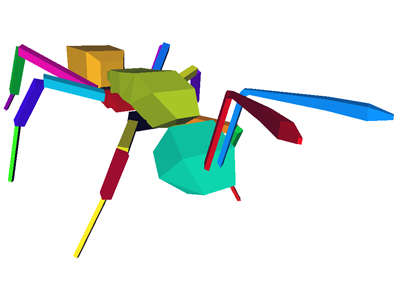 Ant model from PSB with disjoint components identified.
This simple prototype provides a straightfoward method to identify segments in some models from the PSB collection, since they are already coded with disjoint segments.
 Identifying segments using disjoint components in a model from PSB.
 Ant model from PSB with disjoint components identified.
This simple prototype provides a straightfoward method to identify segments in some models from the PSB collection, since they are already coded with disjoint segments.
 Identifying segments using disjoint components in a model from PSB.
Wednesday, July 30, 2008
Keeping words together
I needed to keep two words together in the same line while writing a document with Microsoft Word. Although this is easy to do in LATeX, I have no idea how to do it in Word. After a few searches, I found out that it is even simpler. If one wants to keep to words separated by a space together, just have to use a non-breaking space instead of a "traditional" space.
To insert a non-breaking space in Microsoft Word simply press <CTRL>+<SHIFT>+<SPACE> instead of <SPACE>.
To insert a non-breaking space in Microsoft Word simply press <CTRL>+<SHIFT>+<SPACE> instead of <SPACE>.
Monday, July 28, 2008
Professor Randy Pausch died on July 25th
Last friday, July 25th, Professor Randy Paush died of complications from pancreatic cancer. I have no words to describe the loss it represents not only for the computer science community, but for all the academic world. You can read more at the CMU page.
Monday, July 21, 2008
Paper accepted at SketchWS
The paper titled "EditION: A Collaborative Calligraphic Tool to Manage Virtual Environments" has been accepted for presentation at the 2008 IEEE Symposium on Visual Languages and Human-Centric Computing workshop Sketch tools for diagramming. According to reviewers comments, it needs just a few changes. Let's work on that!
Wednesday, July 16, 2008
Results for CaS collection decomposition
In order to allow a quick analysis of the XML file produced by the Collection-aware Segmentation (CaS) algorithm, I wrote a simple XSL transformation that shows CaS results in an easily readable format.
For instance, here you can take a look at the result of decomposing the Flat-Thin Components cluster from Purdue's ESB with CaS.
For instance, here you can take a look at the result of decomposing the Flat-Thin Components cluster from Purdue's ESB with CaS.
Subscribe to:
Posts (Atom)